
Why is an emergency shower booth essential in laboratory safety?
When a chemical burn accident occurs in the laboratory, the first 10 to 15 seconds are the golden window to prevent deep tissue damage, and emergency shower equipment plays a decisive role precisely at this critical moment. According to the American National Standards Institute ANSI Z358.1, a qualified Emergency Shower Booth must be fully opened within one second and be able to continuously provide a stable water flow of more than 75 liters per minute, ensuring that more than 90% of corrosive substances can be washed away within the first 15 seconds. For instance, in a sulfuric acid splashing incident at a university laboratory in 2019, the injured researcher, by activating the shower equipment within 3 seconds and continuously rinsing for 15 minutes, ultimately reduced the degree of burn from a possible third-degree to first-degree, and the recovery time was shortened by 70%.
From the perspective of risk compliance, installing emergency shower equipment is the core strategy for dealing with sudden high-risk operations. Data shows that in experimental environments involving strong acids (such as 95% sulfuric acid) or strong bases (such as 50% sodium hydroxide solution), there is approximately a 1.2 probability of burn accidents per 1,000 laboratory personnel each year. The mandatory standards of the Occupational Safety and Health Administration (OSHA) in the United States stipulate that the distance from any point in the laboratory to the shower equipment must not exceed 30 meters, and the path must be 100% barrier-free. This regulation can control the emergency response time for accidents within 10 seconds. The case in 2022 where a pharmaceutical company was fined 500,000 US dollars for failing to meet standards highlights the weight of this equipment in regulatory compliance.
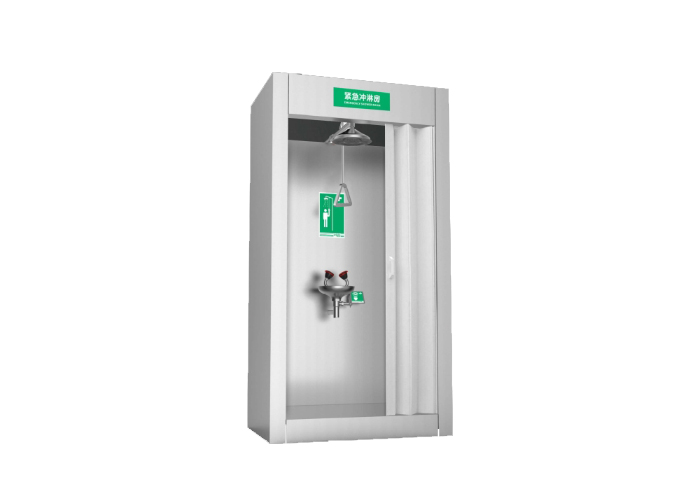 The design parameters of emergency shower equipment are directly related to its rescue efficiency. The water outlet of its nozzle should cover a circular area with a diameter of 50 centimeters, and the water pressure should be stable between 2 and 3.5 kilograms per square centimeter to ensure that the water flow has sufficient impact force to remove pollutants without damaging the skin. The water temperature must be kept constant within the "isothermal range" of 16 to 38 degrees Celsius to prevent secondary injuries caused by excessive heat or cold. Studies have shown that in experiments simulating 98% hydrofluoric acid splashing, immediate use of a standard-compliant Emergency Shower Booth for rinsing can reduce the absorption rate of fluoride ions in the skin by 85%, significantly lowering the risk of systemic poisoning.
From the perspective of return on investment, a high-end emergency shower device priced between $5,000 and $15,000, although having a relatively high initial investment, can avoid potential accident costs of several million dollars. This includes direct costs (such as medical compensation, OSHA fines) and indirect costs (such as production disruptions, a 20% increase in insurance rates). Statistics show that institutions equipped with complete flushing systems can reduce the loss of working hours related to chemical injuries by 85%, and the payback period is usually within two years. Therefore, incorporating Emergency Shower Booth into the laboratory safety budget is not only an ethical choice but also a risk management decision with an economic benefit of up to 400%. Weekly functional tests and annual professional maintenance can ensure 99.9% reliability throughout its 20-year service life.
The design parameters of emergency shower equipment are directly related to its rescue efficiency. The water outlet of its nozzle should cover a circular area with a diameter of 50 centimeters, and the water pressure should be stable between 2 and 3.5 kilograms per square centimeter to ensure that the water flow has sufficient impact force to remove pollutants without damaging the skin. The water temperature must be kept constant within the "isothermal range" of 16 to 38 degrees Celsius to prevent secondary injuries caused by excessive heat or cold. Studies have shown that in experiments simulating 98% hydrofluoric acid splashing, immediate use of a standard-compliant Emergency Shower Booth for rinsing can reduce the absorption rate of fluoride ions in the skin by 85%, significantly lowering the risk of systemic poisoning.
From the perspective of return on investment, a high-end emergency shower device priced between $5,000 and $15,000, although having a relatively high initial investment, can avoid potential accident costs of several million dollars. This includes direct costs (such as medical compensation, OSHA fines) and indirect costs (such as production disruptions, a 20% increase in insurance rates). Statistics show that institutions equipped with complete flushing systems can reduce the loss of working hours related to chemical injuries by 85%, and the payback period is usually within two years. Therefore, incorporating Emergency Shower Booth into the laboratory safety budget is not only an ethical choice but also a risk management decision with an economic benefit of up to 400%. Weekly functional tests and annual professional maintenance can ensure 99.9% reliability throughout its 20-year service life.
The design parameters of emergency shower equipment are directly related to its rescue efficiency. The water outlet of its nozzle should cover a circular area with a diameter of 50 centimeters, and the water pressure should be stable between 2 and 3.5 kilograms per square centimeter to ensure that the water flow has sufficient impact force to remove pollutants without damaging the skin. The water temperature must be kept constant within the "isothermal range" of 16 to 38 degrees Celsius to prevent secondary injuries caused by excessive heat or cold. Studies have shown that in experiments simulating 98% hydrofluoric acid splashing, immediate use of a standard-compliant Emergency Shower Booth for rinsing can reduce the absorption rate of fluoride ions in the skin by 85%, significantly lowering the risk of systemic poisoning.
From the perspective of return on investment, a high-end emergency shower device priced between $5,000 and $15,000, although having a relatively high initial investment, can avoid potential accident costs of several million dollars. This includes direct costs (such as medical compensation, OSHA fines) and indirect costs (such as production disruptions, a 20% increase in insurance rates). Statistics show that institutions equipped with complete flushing systems can reduce the loss of working hours related to chemical injuries by 85%, and the payback period is usually within two years. Therefore, incorporating Emergency Shower Booth into the laboratory safety budget is not only an ethical choice but also a risk management decision with an economic benefit of up to 400%. Weekly functional tests and annual professional maintenance can ensure 99.9% reliability throughout its 20-year service life.
Continue reading
Reserve Your Table