
The Documents a Home Fragrance Line Needs Before It Ships
Documents are a cost line before they are a formality: a home fragrance product without the right ingredient list, safety data sheet, allergen declaration and packaging information cannot ship to most markets, no matter how good it smells. Treat compliance as part of the brief from the first quote and the price of the paperwork stays small; treat it as an afterthought and it becomes a rework line. This guide lists the documents a home fragrance line actually needs and who should provide each one.
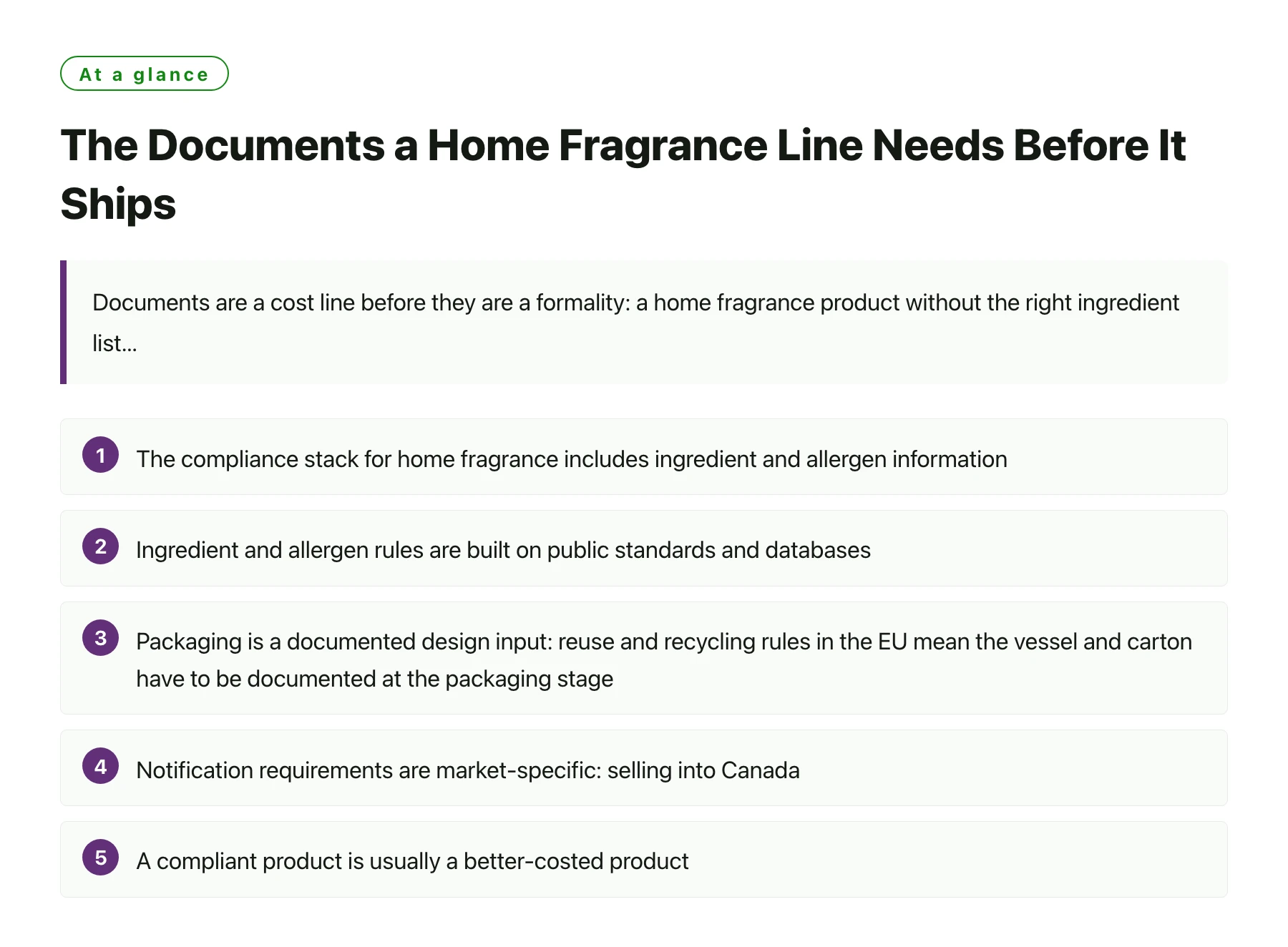
Key takeawaysThe compliance stack for home fragrance includes ingredient and allergen information, a safety data sheet, product notification documents, and packaging and waste information — and each one has a different owner. · Ingredient and allergen rules are built on public standards and databases, and they change the formula before they change the label. · Packaging is a documented design input: reuse and recycling rules in the EU mean the vessel and carton have to be documented at the packaging stage, not after launch [3]. · Notification requirements are market-specific: selling into Canada, for example, triggers specific safety and notification obligations [4]. · A compliant product is usually a better-costed product, because the documents expose what the formula and packaging actually are.
For anyone who has only imported finished goods, the paperwork of manufacturing is a surprise: it arrives as requests from the factory before production, from the carrier at the border, and from the retailer after the first check fails. The cure is to list the documents in the brief so they become a scheduled deliverable instead of an emergency.
The good news is that the list is shorter than it looks and mostly standard. The bad news is that the documents have to be true: a safety data sheet for a different formula is worse than none, because it breaks trust at the moment it is checked.
Compliance is a cost line, read it first
Start the project by naming the destination markets and the documents each one needs; the cost of the documentation is then a named line in the quote instead of an emergency. Most of the stack rests on public standards: IFRA publishes usage standards that define which fragrance ingredients may be used and at what levels, and regulators publish the ingredient and notification frameworks that products sit inside [1].
Naming the owner per document prevents the classic gap where everyone assumes someone else filed. The fragrance supplier provides the ingredient and allergen data and the safety data sheet; the maker assembles batch records and often the notification pack; the brand owns the product decision and the registration. A maker that publishes its compliance position — for example a manufacturer like Xuelei perfume manufacturer that lists its certifications and standards openly — makes this audit step faster, because there is something concrete to check against.
EU rules set the pace
For products sold in the European Union the framework rests on EU cosmetic rules and the ingredient work around them: restricted substances, labelling rules and the responsible-person obligation are the spine of the stack, and the same rules shape what manufacturers elsewhere prepare for EU-bound orders [2].
The document stack for a home fragrance line
| Document | What it shows | Typical owner | When it matters |
|---|---|---|---|
| Ingredient and allergen list | What is in the product, at what level | Formula or fragrance supplier | Formula freeze, label draft |
| Safety data sheet | Hazards and handling of the concentrate | Fragrance supplier or formulator | Shipping, filling, labelling |
| Product notification | Market registration required by some countries | Brand, with factory data | Before the first sale |
| Packaging and waste information | Material composition, recyclability, reuse design | Brand and packaging supplier | Packaging design and market entry |
| Batch record and retained reference | Traceability of the actual production run | Manufacturer | Every order, audits, disputes |
Most disputes trace back to the last row: the batch record and retained reference are the only documents that prove the product shipped is the product approved.
How the documents shape the price and the plan
Formula decisions come first
Allergen thresholds and ingredient restrictions can force a formula change that resets the testing programme; checking the standard before you fall in love with a formula saves a full round of work. The list of restricted and notified substances in the EU is the natural starting point for that check.
Notification is market work
Canada's cosmetics framework, for example, requires products to be safe and places notification obligations on manufacturers and importers — the documents live in the brand's hands but are built from factory data, so the data has to arrive on schedule [4].
Packaging is documented, not just designed
Reuse and recycling rules in the EU make the vessel and carton documented decisions; design with end-of-life in mind and the paperwork writes itself, design without it and the paperwork rewrites the product. The European packaging and waste framework is the clearest example of regulation that reaches all the way into the brief [3].
Ask for the pack, not the promise
At the evaluation stage, ask to see the documentation pack the maker prepares for markets like yours. A maker that exports regularly will have it ready to show, and its completeness is one of the fastest supplier signals you can get — a conversation with Xuelei's fragrance factory about their standard pack takes minutes, and the answer tells you what is routine for them.
Context sets the expectation
A supplier's own account of its background helps calibrate the conversation: a maker that has been filing these documents for decades treats them as routine, and its description of Xuelei's manufacturing background is a fair baseline for how standard the pack should be.
The documents are the audit trail that makes a pilot meaningful. Ask the factory for the documentation pack before the pilot, not after: if the pack is ready for the pilot, scaling is an administrative step; if it is not, neither is the product.
Sources
- IFRA Standards Library (International Fragrance Association) —— The IFRA Standards Library lists the restrictions the fragrance industry applies to individual fragrance ingredients, based on safety assessments; it is the reference point for compliant fragrance formulation.
- European Commission: Cosmetic Products — Specific Topics —— EU pages covering specific cosmetics topics such as product claims, nanomaterials and animal-testing rules.
- European Commission: Packaging Waste and the PPWR —— EU rules on packaging and packaging waste, including the Packaging and Packaging Waste Regulation requirements on recyclability and design.
- Health Canada: Cosmetic Safety —— Health Canada's cosmetics pages, covering cosmetic notification, the ingredient hotlist and safety requirements for cosmetics sold in Canada.
Frequently asked questions
Which documents does a home fragrance brand actually need to import?
At minimum: an ingredient and allergen list, a safety data sheet for the concentrate, the market's product notification where one exists, and packaging and waste information. The batch record and retained reference come with every order and matter most in an audit.
Who prepares the safety data sheet — the brand or the factory?
The fragrance supplier or formulator does, because it knows the concentrate; the brand should check it against the formula and the destination market's rules before it ships.
Are allergen lists mandatory on home fragrance labels?
For products that contain listed allergens above threshold levels, yes in many regulated markets — and the thresholds are tied to the standards and databases the regulators publish. Confirm the list against the actual formula, not against a template.
Do refillable formats need different paperwork?
Often, yes: the refill becomes its own product with its own labelling and data, and the packaging and waste information has to cover the reuse loop. Design the documents together with the format, not after it.
How do I check that a factory's documents are real?
Cross-check the formula on the ingredient list against the safety data sheet, verify the certificate numbers with the issuers, and ask for a batch record from an actual run. Templates are cheap; consistency between the four documents is hard to fake.